
Each chapter outlines exactly how common-sense and healthy change can and has happened in companies, and gives clear guidelines on what the change leader needs to do to replicate the same successes, time after time.
Sample Contents:
Part I: The Organization of the Future
1 Why Change?
2 Setting Your Course
3 Jump-Starting Change
4 The ‘Infomated’ Customer
5 Getting Fast and Flexible
6 Building a Better Path
Taking Charge of the Future
7 Changing the Company’s Mind
8 Planting your Own Feet: Positioning Yourself for the Future
9 Coping with Tomorrow
Part III: Leading Others
10 New Age Leadership
11 Guiding Through Change
12 Managing in the InfoWorld
13 Change Reactions
14 Resistance to Change
15 Overcoming Resistance to Change
A vintage but common-sense leadership book on how to manage change and overcome resistance with strategies that work. Used by Ritz Carlton Hotels and American Express Financial Services in their change efforts. Although written several years ago, it’s guidelines are current and highly useable.
Plant your Feet Firmly in Mid-Air: Guidance Through Turbulent Change. A review by Jeff Davidson
Plant Your Feet Firmly in Mid-Air addresses how to develop the skills needed in the modern organization, to build and rebuild trust, to develop an effective leadership style for the new era, to overcome resistance to change, and to employ new ways of thinking. This is not a book about management theory; rather, it is a book that offers real solutions to the very real problems that managers, executives, and entrepreneurs, face on a daily basis.
The author identifies and explains personal mastery skills to guide you through current turbulent changes toward productive outcomes. The principles and practices outlined in this book can make you a better manager of behavioral change than you are today.
Dr. Janet Lapp is a gifted observer of structures, dynamics, and people. With clarity, wit, style, and insight, she shows employees and managers how to thrive in the throes of change. I highly recommend this book to anyone seeking clear and helpful information about guiding today’s organizations.
AUTHOR'S COMMENTS:
Many organizations appear to have joined the ‘new wave,’ or the new way of doing business, their people and management systems are stuck in the first wave, that is, in the old way of doing business and of managing people. The dissonance created by these two competing systems has created unprecedented and uncomfortable turbulence in today’s corporation. It is as if two storm fronts are clashing, and although we know the air will be turbulent, it is nonetheless confusing, and occasionally frightening. This book was designed to guide through this current dissonance created by two competing systems toward the calmer weather of consonance and stability.
Unfortunately, many of the familiar guideposts are missing as we travel. Imagine you are seated comfortably in an airline seat, waiting at the gate. You watch the luggage and meals being loaded, hear the familiar announcements, and feel the push back, taxi and take-off. You enjoy the topography of the land as it zooms out of view. But then, suddenly, everything becomes clouded. You lose all sense of position. Nothing is anchored. There are no indicators to judge distance. You have simply to trust that the pilot is taking you to your destination.
If you are the pilot, however, a different picture emerges. There are reliable guides through the clouds. Even when the sky is occluded, pilots believe their instruments can lead them faithfully to their destination. Similarly, even though transformational change can be described as leaving the known and venturing into the unknown, there are instruments to guide us, as well. Much of the skill upon which I have relied as an instrument pilot can be transferred to guiding change in times of confusion and ambiguity, and this is the source and focus of much of my writing.
This book developed for two primary reasons: first, I became dissatisfied with materials presently available to help people during the chaotic changes in today’s companies. Many materials offer theories which, although intriguing and perhaps heuristically useful, nonetheless do little to guide today’s manager. In-Plant Your Feet Firmly in Mid-Air, I have tried to outline clear steps toward change, and offer suggestions that today’s managers and staff persons can follow. The second reason this book developed, was to try to help alleviate the real pain and confusion I observe throughout North America when I travel and work with various corporations and associations. At the same time, I am awed by the herculean efforts of courageous people in today’s companies who are valiantly trying to cope with uncertainty, confusion, and overwork. There are masses of employees at all levels who exhibit a committed caring about their work and their fellow workers. These people don’t need theories! They need real answers, strategies, ways of thinking, and acting based on common-sense to help them steer through turbulence. I believe that this book addresses those people and their needs, while simultaneously offering their leaders the tools to better guide them.
Richard Pascale, in Managing on the Edge (1993), argues that the complex messages eluding us these days are common-sense and that there are not, and never have been, short-cuts to ‘good management.’ Additionally, to really understand how highly rated companies work, we also need to study why others can fail. Chapter One examines some of the possible causes of failure.
Some challenges to current common-sense seem to be that the most popular business gurus reflect North America's obsession with the new. Similar to some psychotherapies, in which the very newness of a therapeutic technique provides the cure, there is the admonition in business circles to ‘hurry up and use the new technique while it still works.’ The generated hope can gather enough momentum and power to act as a placebo. Tom Peters captured this ‘new’ spirit when he coined the axiom, ‘Get Innovative or Get Dead.’ But unfortunately, subjecting any organization to repeated epidemics of ‘hit or miss,’ trial-and-error roller coasters, replete with fancy jargon, demoralizes employees, confuses customers and eventually, obscures the very purpose of the business.
Ray Rasmussen, from the University of Alberta, has stated that in hawking trendy ideas such as ‘excellence,’ ‘seven habits’, and ‘learning organizations,’ business gurus all too often ignore the sweat and tears–the human factors–it takes to manage a company well. For example, Tom Peters and Robert Waterman Jr.’s In Search of Excellence (Peters & Waterman, 1982), identified the so-called immutable secrets of excellence in 43 companies. Yet, five years later, most of the anointed companies were no longer considered excellent and some, such as Atari Corp., Digital Equipment Corp., Revlon Inc., Avon Products Inc., Wang Laboratories Inc., and IBM Corp., have even experienced some quite un-excellent adventures.
According to Drucker (1980), organizations operate on a set of sacred, unwritten, powerful, and pervasive assumptions. Unless this set of corporate beliefs shift along with other changes, quick-fixes in the form of Total Quality Management, Total Customer Service, and similar programs, may do more harm than good. To create new organizations with staying power, that can create jobs for the future, and growth for our economies, the corporate mindset must change. Chapter Seven offers several suggestions on how to overcome blocked corporate culture and vision.
Michael Hammer and Jim Champy in Re-engineering the Corporation: A Manifesto for Business Revolution admit that 70% of re-engineering efforts fail to achieve any desired results (Hammer & Champy, 1994). One reason they propose for this is that everyone involved in a process looks inward toward their department and upward toward their boss, but no one looks outward toward the customer. Chapters Four to Six in this book provide guidance toward recognizing and serving the ‘New Customer’ with an info-business, more speed, and by building a better path.
In Chapter Eight, we see that control over our own behavior and some perceived control over our environment is central to change taking hold and becoming fundamental. The more control we have or perceive, the more willing we are to risk further change.
The leaders who make the biggest difference in today's organizations are those who, regardless of job or level, determine how to inspire people through the dynamics of change itself. Chapter Ten gives guidance on how to develop the leadership behaviors that today’s organization needs.
Unless genuine culture change accompanies process redesign, improvements will be typically ineffectual and short-lived. Re-engineering does not focus on the leadership skills needed for change. The leaders’ behavior is fundamental to creating and sustaining a truly successful alteration in course and direction. Chapters Eleven and Twelve will help you to guide yourself and others through change.
If you wish to manage individuals during change, it is important to learn how to overcome resistance to change and increase the control over their workplaces. Chapters Fourteen and Fifteen address resistance to change, and gives suggestions on how to help others climb on board the change effort.
However, one caveat: by nature, change is chaotic. One can’t ever completely manage it, control it, or master it. One can only recognize that it is unpredictable and shapeless in its essence and that no book, method, seminar, or course of study will ever make it completely comfortable and clear. But what we can do is to understand that it is not understandable, and learn to adjust to the unfamiliarity and ambiguity of it.
This book can help anyone in an organization faced with learning new and different ways of effecting, and coping with, change, whether a front-line employee who has to learn different practices of operation, communication, or service, someone in finance, sales, marketing, research, or engineering now needing new skills, or a supervisor or manager in a small to the mid-size company charged with leading change.
Most importantly, this is not a book about what’s wrong. It is a book about what is right, hopeful, and workable. The principles identified and explained herein can make you a much better guide of behavioral change than you already are. I hope this book guides you on your journey to an exciting future.
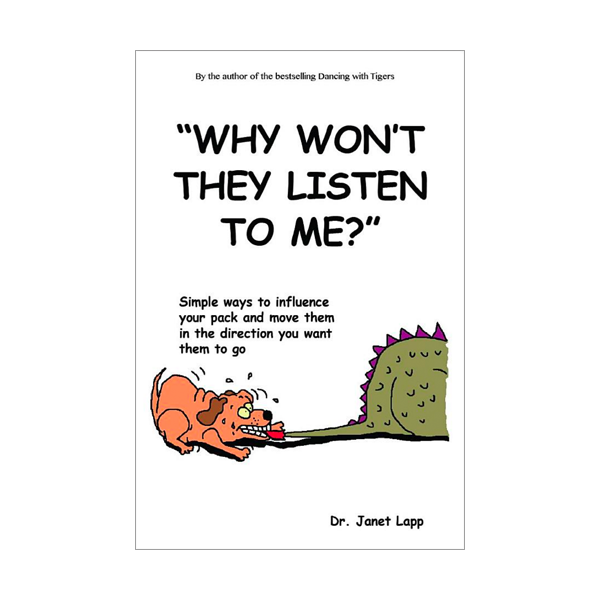
173-page softcover Book
Simple steps to influence your pack
Although geared to parents of kids young and old who won’t listen, this book will increase your impact and influence in all leadership arenas, including in those tough situations at work ... and will help you move your pack in the direction it needs to go.
CONTENTS
Chapter 1 Why Aren’t They Listening?
Chapter 2 The Quick Fix
Chapter 3 Quick-Fix Kids
Chapter 4 Changing the System
Chapter 5 Ground Rules
Chapter 6 5 C’s: Compassion
Chapter 7 Confidence and Clarity
Chapter 8 Commitment and Consistency
Chapter 9 Acting Out
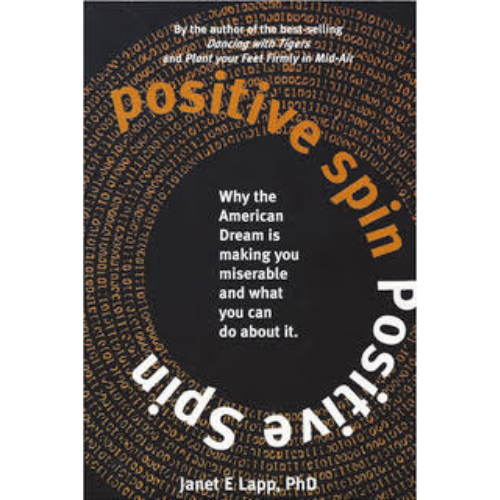
224-page softcover Book
The Real American Dream
This book is jam-packed with evidence on how to adjust oneself for happiness, and what the research says is important for happiness as an individual and a culture.
CONTENTS
Part One: The Search for Happiness
Chapter 1: Life, Liberty, and the Purchase of Happiness
Chapter 2: Let Freedom Ring
Chapter 3: Peace, Order, and Good Government
Part Two: The Evidence
Chapter 4: So If We’re So Rich, Why Are We Miserable?
Chapter 5: If It Ain’t Broke, Don’t Break It. Well, It’s Broke.
Chapter 6: “Maybe If We Moved to California”
Chapter 7: Snow White Was A Snow Job
Chapter 8: War is a Four-Letter Word
Chapter 9: Does Happiness Matter?
Part Three: How to Be Happy (no, really)
Chapter 10: With a Little Help from my Friends
Chapter 11: Happiness: Flow and Faith
Chapter 12: Happiness: The Three Actions
Chapter 13: Happiness: The Four Keys
Chapter 14: Ubuntu: Solution for our World
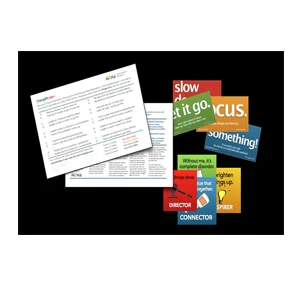
A SET OF 25 DIY CHANGE STYLES ASSESSMENTS
This popular 'behavioral styles' evaluation has been condensed to a 5-minute quiz and self-typing into four familiar personality categories: Directors, Organizers, Connectors and Inspirers. What happens next is what's interesting and useful about this exercise.
Team members affix the appropriate 'type' sticker to themselves and are given a two-sided interaction card. Then they divide into groups with their own style for prepping and feedback. After that, your team is taken through conversations and exercises between styles that will:
* increase empathy and understanding of different types
* pave the way for better and healthier communication
* make difficult conversations much easier
* reduce stress and resentment in the workplace.
Your package includes:
* 25 Change Styles cards
* 10 each of stickers and cards
* Set of instructions and exercises

Note. This book includes a softcover Four Elements Journal.
Create Radical and Sustainable Personal Change
Have you read books that advise you to “transform” your life, but fail to lay out the steps you can take that actually work?
This book lays out tested steps that actually work to create the results that you want.
Begin by developing your base, then learn to focus and self-discipline, keep your energy high and your emotions in check and finally, expand your work into where you know it could go.
The Four Elements system explains how to discover and develop the Elements in their correct order. Complete exercises are given in the Four Elements Journal that stamp in changes. By following this system, change can be radical and sustainable.
In the First Element, define your authentic self and get clear on what you were meant to express. Learn how to bring accountability and responsibility into your life and into the lives of those around you.
In the Second Element, create order in your world. Focus and control distractions. Learn why clutter and scatter can block your growth, and what to do about them. Control worry.
Element Three helps you balance energy, manage energy reserves, and manage stress. It guides through releasing attachment to unhealthy people and thoughts.
Element Four guides you through expansion, growth, courage, solid risk-taking, and wealth creation. How many of the following statements reflect what you think you need?

213-page softcover Book
Courage and Encouragement
Janet’s best-selling book to inspire you to overcome personal blocks toward a life of fulfillment and abundance is a warm book of encouragement, optimism, and overcoming.
SAMPLE CHAPTER TITLES
You Can Get There From Here
“So, What Good Have You Done?”
“Why Does It Always Turn Out The Same?”
Be at Choice
Where Do I Start?
The Truth Shall Set You Free
Boundaries
This is Too Hard; I Want to Quit
Mistakes and Other ‘Imperfections’
“NO, I’M NOT ANGRY”
If Only They Knew How Little I Know
“I Just Want To Be Happy”
How To Be Miserable
Give Yourself A Break
“You Are Such A Loser”
MESSING UP
“Oh Well, It’s Better Than Nothing.”
How To Cut The Rope
If Only I Had More Money
Dump It!
Help! I’m Losing Control
But I Would Feel Guilty!
Start It Now
Why Won’t People Do What I Want?
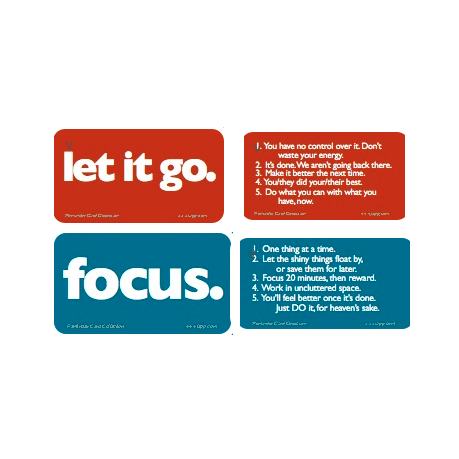
The top two blocks to success both for individuals AND for companies are:
1.Lack of focus, whether individual scatter due to overload or lack of training ...
2. Wasting energy and resources by hanging on to what no longer works.
The business-card size with rounded edges is so easy to stick up on your computer or give to friends ... these glossy cards contain a reminder on one side and steps to make it happen on the other side. Simple and comforting reminders during chaotic changing times.
Each card sold in neat packs of 10.

Used by top companies to provide continual reminders of leadership essentials, these cards provide capsule summaries of well-researched leadership guides on compact easy-to carry business-size cards.
Topics include decision making, optimism, courage, delegation, innovation, self-knowledge, values focus, clarity, servant leadership, and others for a total of 14 cards.

238-page softcover book
Each chapter outlines exactly how common-sense and healthy change can and has happened in companies, and gives clear guidelines on what the change leader needs to do to replicate the same successes, time after time.
Sample Contents:
Part I: The Organization of the Future
1 Why Change?
2 Setting Your Course
3 Jump Starting Change
4 The ‘Infomated’ Customer
5 Getting Fast and Flexible
6 Building a Better Path
Taking Charge of the Future
7 Changing the Company’s Mind
8 Planting your Own Feet: Positioning Yourself for the Future
9 Coping with Tomorrow
Part III: Leading Others
10 New Age Leadership
11 Guiding Through Change
12 Managing in the InfoWorld
13 Change Reactions
14 Resistance to Change
15 Overcoming Resistance to Change
A vintage but common-sense leadership book on how to manage change and overcome resistance with strategies that work. Used by Ritz Carlton Hotels and American Express Financial Services in their change efforts. Although written several years ago, it’s guidelines are current and highly useable.